The Music Blog · Rishikesh

Writing About Music, From the Riverbank.

Notes from a small teaching room at Laxman Jhula, where the Ganga is loud enough to tune against. Essays on Naad and raga, rhythm and breath, riyaz and listening — written the way we actually teach, without shortcuts and without mystification.

All Writing Naad & Philosophy Raga Studies Sur · Laya · Taal Theory & Shrutis Instruments Riyaz & Practice Kirtan & Mantra The Art of Listening
Editor's Pick

Start With This One.

If you read only a single piece from this journal, read the essay that everything else quietly depends on.

Featured Essay Sound and silence beside the Ganga in Rishikesh
Philosophy of Sound 12 min read Amresh Kumar

Naad: Why Indian Music Begins With Sound Itself, Not With Notes

Western theory usually starts with a note. Indian music starts one step earlier — with the claim that sound is not something added to the world but the material the world is made from. It sounds abstract until you notice how completely it reorganises the way a musician practises, listens, and decides what counts as a mistake.

Read the essay
All Writing

Eight Essays on Indian Music.

Each one is a full piece rather than a summary — theory where theory helps, and plain language everywhere else. Read straight through, or jump to whatever you are struggling with this week.

Naad and the philosophy of sound01
Philosophy12 min

Naad: Where Sound Comes Before the Note

Anahata and ahata naad, sound as the substance of creation, and what that actually changes about your next practice session.

Read
Raga and time of day02
Raga Studies14 min

Raga and the Clock: Ragas That Belong to Hours

Samay chakra, the eight prahar, and why a raga played at the wrong hour can be technically perfect and still feel wrong.

Read
Sur laya and taal03
Fundamentals11 min

Sur, Laya, Taal: The Three Pillars

Pitch, tempo and cycle are three separate disciplines. Weakness in one always turns up disguised as a problem in another.

Read
Sargam and the shrutis04
Theory13 min

Sargam and the Twenty-Two Shrutis

Why twelve notes cannot explain Indian music, and how the space between them produces the sound you instantly recognise.

Read
The bansuri bamboo flute05
Instruments12 min

The Bansuri: Six Holes, One Breath

How bamboo became Krishna's instrument, why breath outranks finger speed, and how to choose a first flute you will not regret.

Read
Daily riyaz practice06
Practice11 min

Riyaz: The Unglamorous Habit That Decides Everything

Why forty focused minutes beat three distracted hours, and how to build a routine that survives a normal, busy life.

Read
Kirtan and mantra chanting07
Devotional10 min

Kirtan and Mantra: Music Not Meant to Be Performed

Call and response, repetition as a technique rather than a shortcut, and why the least trained voice is often the most useful.

Read
Learning to listen to Indian classical music08
Listening12 min

How to Listen: The Skill Nobody Teaches

A practical method for turning passive enjoyment into active recognition — the fastest improvement available to any student.

Read
Philosophy of Sound

Naad: Why Indian Music Begins With Sound Itself, Not With Notes

Essay 01 12 min read Amresh Kumar Laxman Jhula, Rishikesh

There is a question I ask students on the first day, and almost nobody answers it the way they expect to. Not what do you want to play — but what do you think sound actually is?

Most people describe sound as something that happens: a vibration in air, a wave hitting an eardrum, an event with a beginning and an end. That description is correct and it is also the reason so many students arrive with a subtle handicap. If sound is an event, then music is a series of events, and practising music becomes the business of arranging events more skilfully. Faster. Cleaner. More impressively.

Indian musical thought begins somewhere else entirely. It begins with नादnaad — the proposition that sound is not an event inside the world but the material the world is assembled from. Not a thing that happens in space, but the thing that space happens in.

You can treat that as poetry if you like. Many students do at first. But it is worth sitting with, because it is not decoration on top of the music. It is the load-bearing idea, and once you accept it, a great many practical decisions stop being arbitrary.

Anahata and Ahata: Two Kinds of Sound

The tradition splits naad into two categories, and the distinction is the most useful thing in this essay.

Anahata naad is unstruck sound — sound that is not produced by anything. No string, no breath, no impact. It is described as continuous, prior to and independent of any instrument. In the old texts it is the hum underneath existence, the vibration that does not require a vibrator. If that sounds impossible, note that the tradition never claims you can play it. Only that you can become quiet enough to notice it.

Ahata naad is struck sound — everything a musician can actually make. A finger on a string, a breath across a bamboo edge, a palm on stretched skin, air pushed through vocal folds. All of it. Every note you will ever play in your life belongs to this second, smaller category.

Here is what that arrangement implies, and it is genuinely humbling: the musician does not create sound. The musician disturbs something that was already there, briefly and imperfectly, and then gets out of the way.

“A musician is not a source of sound. A musician is an interruption in a silence that was already complete.”

How the idea is usually put in the teaching room

I labour this point because it changes the emotional temperature of practice. If you are the source of the music, then every bad note is a personal failure, and practice becomes a daily audit of your inadequacy. I have watched talented students quit for exactly this reason. But if the sound is already there and your job is to become a clearer opening for it, then a bad note is simply an obstruction — a piece of information about where you are still in the way. That is a workable relationship with an instrument. You can sustain it for forty years.

The Ganga at Laxman Jhula, Rishikesh, where the sound of water is constant
The river never stops — the first drone any student here learns to hear

Why This City Teaches It Better Than a Classroom

Rishikesh has an unfair advantage as a place to learn this, and it is not the temples or the reputation. It is the water.

The Ganga at Laxman Jhula does not stop. It does not pause between phrases or rest at the end of a line. It produces a broad, unbroken band of sound that sits underneath everything else in the town — under the bells, the traffic on the bridge, the monkeys on the railings, the conversation in the next room. Students who practise here for three weeks start reporting the same thing: they stop hearing the river as noise and start hearing it as a drone. And once you hear it as a drone, you cannot help tuning to it.

That is naad training, and no exercise sheet delivers it. It is simply the experience of a continuous sound that was not made for you, is not about you, and does not require your participation — against which your own playing is revealed as a small, deliberate, temporary act.

A short exercise you can do tonight

Sit for four minutes without an instrument. Do not meditate; do not try to empty your mind. Simply catalogue every sound you can hear, from loudest to faintest, and keep going past the point where you think you have found them all.

Most people stop at five or six sounds. Push to twelve. Somewhere around eight or nine, the quality of your attention changes noticeably — and that changed attention, not the list, is the entire point of the exercise.

Om, and Why the Class Begins With It

Every course at this school opens with chanting. Students sometimes assume this is a religious requirement, and it is worth being precise: it is not. Nobody is asked to believe anything. It is a technical procedure with a specific function, and it happens to be very old.

The syllable is treated as the closest audible approximation of anahata naad — the nearest a struck sound can come to representing unstruck sound. Chanted properly, it moves through three phases and a fourth that is not a phase at all. A opens at the base of the throat with the mouth wide. U travels forward as the lips close. M resonates in the closed mouth and the sinuses. And then the silence afterwards, which the tradition insists is part of the syllable and not merely its absence.

What the chant does in practical terms is three things at once. It warms the vocal apparatus. It slows and lengthens the breath, which lowers a nervous student's heart rate faster than any reassurance from a teacher. And it establishes a shared pitch in the room, so that when the first note of the actual lesson arrives, everyone present is already inside the same tuning.

Fifty seconds of work. It does more than the first ten minutes of most lessons.

The Objection Worth Taking Seriously

Let me put the strongest argument against everything I have just claimed, because students who do not raise it are usually just being polite.

The objection is this: none of it is measurable. Anahata naad cannot be recorded. No instrument detects it. A skilled musician who thinks sound is a pressure wave and nothing more can outplay a devout one who has never practised. If the philosophy were doing real work, surely the philosophically inclined would simply be better players — and they are not.

That objection is sound, and I have no counter-argument to it, because it is aimed at a claim I am not making. The naad framework is not a physical theory competing with acoustics. It never was. It is a framework for attention, and frameworks for attention are judged by what they let you notice, not by what they let you measure.

So judge it that way. Musicians trained inside this framework consistently do things that musicians trained outside it tend not to: they tune obsessively rather than approximately; they treat silence as material rather than as gaps; they hold a single note long enough to hear it change; they consider a rushed phrase a more serious error than a wrong note. Those are not mystical achievements. They are audible, teachable, checkable habits — and the philosophy is what produces them reliably. That is a defensible claim about a useful idea, and it is the only one I want to make.

What Changes on Monday Morning

Suppose you take naad seriously for one month. Four things will change, and none of them are abstract.

You will tune for longer. Not because tuning is virtuous, but because you will start hearing the difference between nearly right and right, and nearly right will begin to grate.

You will hold notes. Beginners play notes; they rarely hold them. A held note has an internal life — it arrives, settles, wavers, and decays — and you cannot hear any of that in half a second.

You will stop filling silence. The impulse to keep playing is almost always anxiety, and it is the most common reason an otherwise good student sounds hurried.

You will practise on bad days. This is the largest one. When the sound is not yours to produce, a bad day is not evidence about your talent. It is weather. You sit down anyway, you notice you are in the way, and you keep going — which over ten years is the only thing that has ever separated the students who arrive from the students who continue.

NaadAnahataNaad Yoga OmPhilosophyRishikesh
Amresh Kumar teaching at Rishikesh Music Class

Amresh Kumar

Founder & Teacher · Rishikesh Music Class

Teaches raga studies, bansuri, tabla, harmonium, voice and Naad yoga one-to-one at Sant Sewa Ashram, Laxman Jhula. Trained in the traditional guru–shishya lineage, and has taught students from more than forty countries in English and Hindi.

Raga Studies

Raga and the Clock: Why Certain Ragas Belong to Certain Hours

Essay 02 14 min read Amresh Kumar

Play Raga Bhairav at nine in the evening and something will be wrong. Every note will be correct. The phrasing may be excellent. And it will still sound like a photograph taken with the wrong lens.

This is the part of Indian classical music that most reliably strikes newcomers as superstition, and I understand why. A note is a frequency. A frequency does not know what time it is. So how can the clock possibly be part of the theory?

It is a fair challenge and it deserves a real answer rather than an appeal to tradition. But before the answer, we need to clear away the misunderstanding that makes the whole subject confusing.

First: A Raga Is Not a Scale

This is the single most consequential error a student can carry, and almost everyone arrives carrying it.

A scale is an inventory. Here are the notes; use them as you wish. A raga is nothing like an inventory. A raga is a set of behavioural rules governing how a particular collection of notes must move — and the notes are the least important part of the definition.

Consider what a raga actually specifies:

Aroha and avaroha — the ascending and descending paths, which are frequently different. A note present on the way up may be forbidden on the way down, or approached from an entirely different direction.

Vadi and samvadi — the most important note and the second most important. The vadi is where phrases gravitate and rest. Change the vadi and you have changed the raga even if the note-set is untouched.

Pakad — the catch-phrase. A short, distinctive figure that identifies the raga the way a few words identify a friend on the telephone.

Chalan — the characteristic gait. Whether the raga strides, meanders, hesitates or leaps.

Now the consequence. Two ragas can share the same notes and sound nothing alike. Bhupali and Deshkar both use the same five notes. Any keyboard would render them identically. Yet no trained listener would confuse them for a moment, because their vadi notes differ, their phrases resolve differently, and one climbs where the other descends. The notes are the raw material; the raga is the grammar.

“You cannot improvise freely until you know exactly what the raga will not allow.”

Teaching principle at Rishikesh Music Class

Once that is clear, the time question becomes answerable, because a raga is a character rather than a colour swatch — and characters behave differently at different hours.

Raga studies at Rishikesh Music Class
Raga — structure, mood, hour and season

The Samay Chakra: Eight Watches of the Day

The traditional day is divided into eight prahar, each roughly three hours, four for daylight and four for night. Ragas are assigned to these watches, and the assignment is not decorative — it is part of how the raga is taught and remembered.

RagaTraditional HourCharacter
BhairavFirst light, 4–7 AMGrave and devotional. Uses komal Re and komal Dha. Feels like a temple before anyone has arrived.
TodiMid-morning, 7–10 AMPlaintive, searching. Heavy with flattened notes, yet somehow bright rather than sad.
SarangMidday, 12–3 PMOpen and unhurried. The heat of the afternoon with nowhere in particular to be.
BhimpalasiLate afternoon, 3–6 PMWarm, gently melancholic. The light going amber. A favourite first raga for many students.
YamanEarly evening, 6–9 PMSerene and expansive. Tivra Ma gives it lift. Almost every syllabus begins here.
BageshriLate night, 9 PM–12 AMLonging, inward. Traditionally the raga of waiting for someone who has not come.
MalkaunsDeep night, 12–3 AMVast and shadowed. Five notes, no Re, no Pa. Enormous internal space.
LalitBefore dawn, 3–6 AMUnresolved, luminous. Uses both forms of Ma. Neither night nor morning.

There are hundreds more, and seasonal ragas layer on top of this — Megh and Miyan ki Malhar for the monsoon, Basant and Bahar for spring. Rishikesh in July, when the rain arrives in sheets and does not stop for days, is an unusually persuasive argument for the monsoon ragas.

So Is the Timing Real, or Is It Convention?

Here is my honest position, and it is a divided one.

Part of it is unquestionably learned association. If a musician spends thirty years hearing Bhairav only at dawn, Bhairav will mean dawn to that musician — and to their students, and to their students' students. That is culture doing what culture does, and it is not a criticism. Almost everything expressive about music works this way. A minor chord is not intrinsically sad either.

But part of it is not arbitrary, and this is where the sceptical view undersells the tradition. Something physical genuinely changes across a day, and it changes for the musician before it changes for the listener.

Your voice at 5 AM is not your voice at 9 PM. The throat is drier, the resonance sits lower, the upper register is not yet available, and the body is not yet braced against the day. Sing a raga full of flattened, close-interval notes in that condition and it fits the instrument you are holding. Sing a bright, wide, leaping raga and you are fighting yourself. Meanwhile the room is different too — at 5 AM the ambient noise floor is perhaps twenty decibels lower, which means quiet ornaments are audible that would simply vanish at nine in the evening.

So dawn ragas are quiet, low-lying and ornament-rich. This is not a coincidence, and it is not mysticism. It is centuries of practical observation about what actually works when the body and the room are in a particular state, encoded as a rule because rules are easier to transmit than explanations.

How we handle it in scheduling

Where the timetable allows, we place a raga in the slot it traditionally belongs to. A student studying Yaman is offered the 5:30 PM class; a student on Bhimpalasi takes an afternoon slot. It costs nothing to arrange and students consistently report the raga making more sense.

That said, no student is ever told they may not practise a raga at the wrong hour. That would be precious and unhelpful. Learn it whenever you can; simply know what it was built for.

Thaat: The Map That Makes the Territory Navigable

Several hundred ragas is an unmanageable amount of information without a filing system, and the system in Hindustani music is thaat — ten parent scales, systematised by Vishnu Narayan Bhatkhande in the early twentieth century.

The ten are Bilawal, Khamaj, Kafi, Asavari, Bhairavi, Kalyan, Marwa, Poorvi, Todi and Bhairav. Each raga is assigned to whichever thaat contains its notes.

Two warnings, because students routinely over-invest in this framework. First, thaat is a filing convention rather than a musical truth; several ragas fit awkwardly and a few fit two thaats depending on who is arguing. Second, knowing a raga's thaat tells you almost nothing about how it sounds — it tells you which notes are available, which we have already established is the least interesting part. Thaat is the index of the library. It is not any of the books.

What Studying Ragas Feels Like From Inside

Progress here is not linear and it is worth knowing that in advance, because the middle of the process feels like failure.

Weeks one to three. You learn the notes of one raga and can play its ascent and descent. You feel you have learned it. You have not; you have learned its skeleton.

Weeks four to eight. The pakad starts to feel inevitable rather than arbitrary. You begin catching yourself playing phrases that are technically inside the note-set but sound wrong, and — critically — you can now hear that they are wrong before your teacher says so. This is the real threshold.

Months three to six. You can identify the raga in recordings you have never heard. Students find this disproportionately thrilling and I have never discouraged it. It is genuine evidence.

Beyond. You start to have preferences — a raga you find hollow, another you cannot stop returning to. Taste is beginning, and taste is what eventually distinguishes a musician from a competent player.

Ten sessions gets a serious student through the grammar and two or three ragas properly. Fifteen adds contrasting moods and the beginnings of alap. Thirty is where genuine repertoire and confident improvisation live. Anything shorter than ten is theory you will forget, which is why we do not offer it.

RagaSamay ChakraPrahar ThaatYamanBhairavMalkauns
Fundamentals

Sur, Laya, Taal: The Three Pillars Every Musician Stands On

Essay 03 11 min read Amresh Kumar

When a student's playing is not working, the cause is almost never where they think it is. They report a problem with their hands. Nine times out of ten the problem is in their sense of time, or in their ear, and the hands are merely where it becomes audible.

Indian music rests on three separate faculties: sur (pitch), laya (tempo and flow) and taal (the metric cycle). They are trained differently and they fail differently. Learning to tell which one is actually broken is the most useful diagnostic skill a student can acquire, and it will save you years.

Sur: Not Hitting Notes, Inhabiting Them

Sur is usually translated as pitch, which is accurate and misleading in equal measure. Pitch suggests a target — you hit it or you miss. Sur is closer to a question of whether a note is genuinely alive.

Here is a distinction worth having. A note can be correct and still not be in sur. If the frequency is right but the note arrives abruptly, sits without resonance, and stops without decaying, a trained listener hears something flat and lifeless even though a tuner would show no error at all. Being in sur means the note is placed with intention, supported by breath or bow or finger pressure, and released rather than dropped.

The instrument that teaches this is the tanpura, or its digital equivalent. A tanpura plays no melody. It provides a drone — usually Sa and Pa — and its only function is to make your pitch errors unbearable. Against silence, a slightly flat note sounds fine. Against a drone, it produces an audible beating that you cannot ignore once you have learned to hear it.

Which is why the first genuine milestone in Indian music is unglamorous: can you sing or play one long Sa that does not fight the drone? Not a phrase. One note. Most beginners cannot, and most beginners are surprised by how much attention it takes.

“Learn one note completely before you learn seven approximately.”

The advice most often ignored, and most often returned to

Laya: The Faculty Almost Everyone Neglects

Laya is tempo, but more precisely it is your internal relationship to the passage of time. It is the least practised of the three and the most damaging to leave weak, because a laya problem masquerades as a technique problem so convincingly.

The classic symptom: a student plays a difficult passage badly and concludes their fingers are not fast enough. Slow the passage down and the fingers manage perfectly. So it was never speed. What happened is that the student accelerated into the difficult part — because difficulty produces anxiety and anxiety produces rushing — and then arrived at the hard notes travelling faster than they could handle. The hands were fine. The clock was broken.

Traditional practice recognises three tempo bands: vilambit (slow), madhya (medium) and drut (fast). Students want to live in drut. Real development happens in vilambit, and here is why that is not merely a moral position: slow tempo removes the possibility of hiding. At speed, an unclear note lasts a fraction of a second and the ear forgives it. At half speed, every imprecision is fully exposed and lasts long enough to be diagnosed.

The clap test

Set a metronome to 60 and clap along for two minutes without looking at it. Then check whether you are still with it.

Most people drift, and the direction of drift is informative. Speeding up usually means anxiety. Slowing down usually means you are listening to yourself rather than to the beat. Both are correctable — but only once you know which one you do.

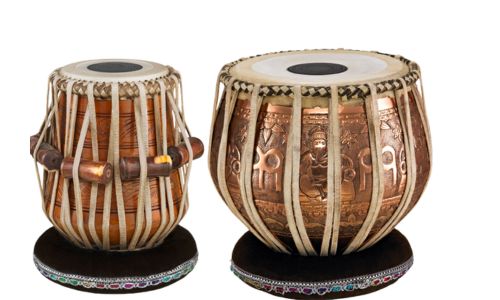
Tabla — the instrument of taal
Tabla — where laya becomes visible and taal becomes physical

Taal: Cycles, Not Bars

Western music generally counts in bars — repeating units of equal weight, one after another. Indian music counts in taal: a cycle with internal architecture, where positions within the cycle carry different weight and meaning.

The vocabulary is small and worth memorising properly:

Matra — one beat, the basic unit.

Sam — beat one. The point of arrival and resolution. Everything in the cycle is oriented toward it, the way a sentence is oriented toward its full stop.

Khali — the "empty" section, marked by a wave rather than a clap and played on the open, lower-pitched drum. It creates a deliberate dip in intensity that makes the return to sam feel like a return.

Vibhag — the divisions the cycle is grouped into.

Bol — the spoken syllables that name each stroke. Dha, Dhin, Na, Ta, Tin, Ge, Ke. You learn to recite a composition before you learn to play it, and this is not a preliminary exercise — reciting is how the rhythm gets into the body.

TaalMatrasWhere You Meet It
Teentaal16The default. Four groups of four, khali on beat nine. Every student starts here.
Jhaptaal102-3-2-3. The uneven grouping is the whole lesson — it teaches you not to assume fours.
Ektaal12Slow khyal vocal. Long, spacious, easy to get lost in until the structure is internalised.
Rupak7Begins on khali. Genuinely disorienting at first, since the cycle opens on its weak point.
Dadra6Light and folk-adjacent. Common in bhajan and thumri.
Keherwa8Everywhere. Kirtan, bhajan, film music. The most heard rhythm in India.

Teentaal is sixteen beats, which sounds simple, and for one cycle it is. The difficulty appears at cycle fourteen, when you are improvising, thinking about your left hand, and must still land precisely on sam without counting. That capacity — knowing where you are in the cycle while your attention is elsewhere — is what years of practice actually buy.

How the Three Interlock

They are separate faculties but they are not independent, and the failure modes cross over constantly. Some patterns I see most weeks:

Good sur, weak laya. Beautiful individual notes; phrases that wander and never resolve where they should. Usually a singer who has never played a percussion instrument.

Good laya, weak sur. Rhythmically watertight, pitch approximate. Usually a student from a guitar or drumming background, where equal temperament and fixed frets removed the need for fine pitch discrimination.

Good sur and laya, no taal. Plays expressively alone, falls apart the moment a tabla joins. The most frustrating case for the student and the easiest to fix — it is almost always insufficient counting practice rather than any deficiency of talent.

The remedy in every case is the same and it is boring: identify the weak pillar honestly, then spend a disproportionate share of your practice on it while maintaining the other two. Students resist this, because practising your weakest faculty feels bad and practising your strongest feels like progress. It is the single most common reason a talented student plateaus for two years.

SurLayaTaal TeentaalTanpuraBolVilambit
Beginning with Shree Ganesha

Every Class Opens With Sound

॥॥ वक्रतुंड महाकाय
सूर्यकोटि समप्रभ।
निर्विघ्नं कुरु मे देव
सर्वकार्येषु सर्वदा ॥॥
ॐ गं गणपतये नमः

Before the first phrase is played, students and guru chant together. It is a short moment, but it settles the room and marks the class as something separate from the day around it — clarity, confidence and the removal of obstacles before learning begins. The Naad essay in this journal is really an attempt to explain why.

Theory

Sargam and the Twenty-Two Shrutis: The Space Between the Notes

Essay 04 13 min read Amresh Kumar

A pianist once sat in my room, played a phrase of Raga Bhairavi on the harmonium with every note correct, and said: that does not sound like the recording. He was right. And the reason is not in the notes he played. It is in the notes between them.

Sargam: The Seven Syllables

Start with the simple part. Indian music names its notes with syllables rather than letters: Sa, Re, Ga, Ma, Pa, Dha, Ni — shortened from Shadaj, Rishabh, Gandhar, Madhyam, Pancham, Dhaivat, Nishad. Together they are sargam.

There is one structural difference from the Western system that matters more than it appears to. Sargam is movable. Sa is not a fixed frequency — it is wherever you decide to put it. A tall man with a low voice puts Sa low; a child puts it high; both are singing the same raga with the same relationships intact. Sa means home, not C.

Two notes never move: Sa and Pa. They are called achal — immovable — and they are the fixed pillars every raga is built between. The other five have variants:

Komal (flattened) forms exist for Re, Ga, Dha and Ni. Written in lower case: re, ga, dha, ni.

Tivra (sharpened) exists only for Ma. Written Mâ or MA.

Seven natural notes, four flattened, one sharpened: twelve in total. At this point the pianist relaxes, because twelve is a familiar number and it looks like the chromatic scale. That relaxation is the mistake.

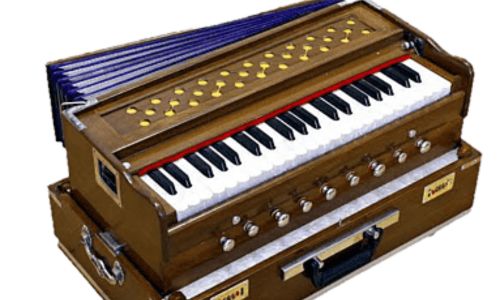
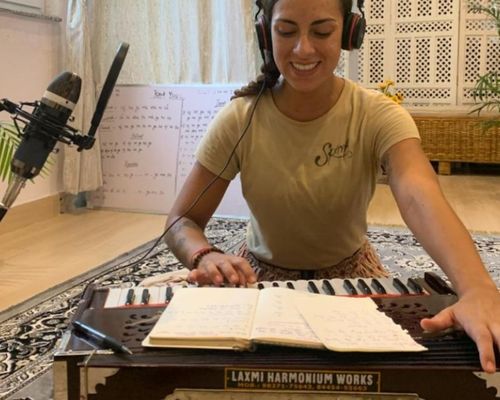
Harmonium — a fixed-pitch instrument in a variable-pitch tradition
The harmonium — twelve fixed keys inside a system that has more than twelve notes

Twenty-Two Shrutis: Where the Systems Part Company

Classical Indian theory does not describe an octave of twelve notes. It describes twenty-two shrutis — twenty-two perceptible pitch positions within an octave.

Two clarifications immediately, because this fact gets mangled constantly on the internet.

First, nobody plays a twenty-two-note scale. A raga still uses five to seven notes. The shrutis are not extra notes you add; they are the available positions from which those notes are selected.

Second, and this is the substance: a note's exact position varies by raga. The komal Ga in Bhairavi is not at precisely the same pitch as the komal Ga in Todi. The difference is small — perhaps ten to twenty cents, a fifth of a semitone — but it is consistent, it is taught deliberately, and it is a large part of why two ragas with identical note-names have distinguishable flavours.

This is why the piano cannot play Indian classical music properly, and it is not a slight against the piano. A piano is tuned to equal temperament: twelve mathematically identical steps, an engineering compromise that lets you change key freely. Indian music never needed to change key — Sa moves with the singer instead — so it never accepted the compromise, and kept intervals tuned to pure ratios against the drone.

IntervalPure RatioAgainst Equal Temperament
Sa1:1Identical. The reference point in both systems.
Pa3:2About 2 cents higher. Effectively the same; the perfect fifth survives temperament well.
Ga5:4About 14 cents lower. Clearly audible against a drone — the sweetest note in the pure scale.
Ni15:8About 12 cents lower. Part of why a tempered major seventh sounds harsh in this context.

Fourteen cents is not a rounding error to a trained ear listening against a sustained drone. It is the difference between a note that locks in and rings, and a note that sits next to the drone producing a faint, restless beating.

Hear it yourself in two minutes

Play a sustained Sa drone. Sing a Ga above it and slide slowly, in the smallest increments you can manage, through the region where Ga lives.

At one specific point the interference stops and the note appears to fuse with the drone — it feels locked, almost effortless. That point is the pure Ga. Now play Ga on a keyboard against the same drone. The difference is not subtle once you have found the locked position.

Meend: Why the Sliding Matters More Than the Notes

Here is the deeper answer to the pianist's complaint. His notes were right. What was missing was everything between the notes.

Indian classical melody is fundamentally continuous rather than discrete. The ornaments are not embellishments applied to a skeleton — they are the connective tissue that makes the phrase a phrase:

Meend — the glide from one note to another, passing audibly through the pitch space in between. On sitar it is a string bend; in voice it is a portamento; on bansuri it is a rolling half-cover of the finger holes.

Kan — a grace note, touched so briefly it colours the main note rather than sounding as a note itself.

Andolan — a slow, wide oscillation on a single note. Not vibrato. Vibrato is fast and decorative; andolan is slow and structural, and in some ragas the note is defined by its oscillation.

Gamak — a heavy, forceful shake, powerful and deliberately unsubtle.

Murki — a fast, light cluster of notes, like a turn, over almost before you hear it.

A phrase written as Sa Re Ga may be played with a slow meend from Sa that touches Re only in passing and arrives at Ga with an andolan. On paper it is three notes. In sound it is a single continuous gesture. Notation cannot capture this, which is precisely why the tradition is transmitted orally, teacher to student, ear to ear — not out of conservatism but because the written form loses the part that matters.

“Western notation tells you where to go. Indian music is largely about how you travel.”

Explaining meend to a classically trained pianist

Do You Need to Read Notation?

No. Not at any stage, and I want to be unambiguous because it deters people unnecessarily.

Bhatkhande notation exists and is genuinely useful for recording a composition so you do not forget it. Students who already read music are welcome to use whatever helps. But the ragas themselves are transmitted by listening, singing back, and repeating until the phrase is in your body rather than on a page. Sargam becomes second nature within a few weeks simply through use.

If anything, strong notation-reading can be a mild obstacle at first, because it encourages you to see music as a series of discrete positions — which is exactly the habit that makes meend hard to learn. Several of my most fluent students cannot read a note of anything.

What to Actually Do With This

Do not try to learn twenty-two shrutis. Nobody does that, and any teacher who sets it as an exercise is confusing scholarship with pedagogy. The theory explains why your ear should be trained; it is not itself a training programme.

Do practise against a drone, always. Every session. This is the mechanism by which shruti sensitivity develops, and there is no substitute for it.

Do learn one raga's exact note placements from a teacher. Hearing that your komal Ga is slightly high for this particular raga, and then correcting it, teaches more than any amount of reading. It also tends to be the moment students first believe the theory is describing something real.

Do imitate before you analyse. Copy your teacher's phrase precisely, including the slides you cannot yet name. Understanding arrives afterwards, and it arrives faster this way round.

SargamShrutiKomal TivraMeendAndolanJust Intonation
Instruments

The Bansuri: Six Holes, One Breath, and an Entire Tradition

Essay 05 12 min read Amresh Kumar

A bansuri is a tube of bamboo with holes burned into it. There is no reed, no key, no mechanism, no moving part of any kind. It is arguably the least sophisticated object in Indian classical music, and it is capable of everything the tradition asks for.

I find this worth dwelling on. Nothing about a bansuri helps you. A piano gives you the note the moment you press the key. A guitar's frets place the pitch for you. A bansuri gives you an edge to blow across and leaves every other variable — pitch, tone, volume, stability — entirely to your face. Which is why it is simultaneously the cheapest classical instrument to buy and one of the least forgiving to begin.

Krishna's Instrument, and Why That Is Not Incidental

In Indian iconography the flute belongs to Krishna, and the association is unusually specific. Krishna does not merely play the flute; the flute is how he calls. The gopis leave their homes at the sound of it. The cattle turn toward it. It is depicted as an instrument of irresistible summons rather than of performance.

There is a well-known image in the devotional literature that I think about often: the flute is hollow, and that is its entire qualification. It has nothing of its own to say. It makes music only because it is empty enough for breath to pass through unobstructed.

You may take that as theology or as a technical note about ego. Either reading points the same direction, and it connects directly to the idea of naad — the musician as an opening rather than a source.

“The flute is honoured for being empty. Nothing is asked of it except that it not obstruct.”

The image most often repeated about the bansuri
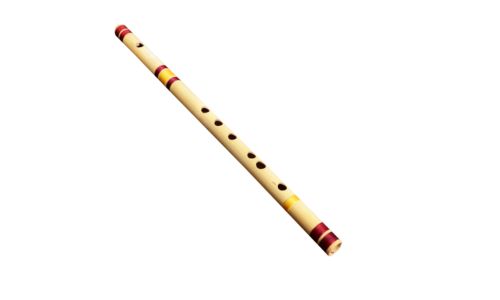
Bansuri bamboo flutes used at Rishikesh Music Class
Bamboo, six holes, and no mechanism to hide behind

Phook: The Part Everyone Underestimates

New flute students believe their problem will be fingers. It never is. The problem is phook — the blowing.

Getting any sound at all takes most people between ten minutes and two days, and this initial failure is completely normal. The embouchure hole must sit against the lower lip at a particular angle, and the airstream must be narrow, focused, and directed at the far edge of the hole so that it splits. Too much air and you get breath noise. Too little and nothing. Wrong angle and nothing. The margin is small and invisible, and no one can adjust it for you — a teacher can only describe it and listen.

Once the first note appears, the real work starts, and it is all breath:

Diaphragmatic support. Chest breathing produces a wobbling, short-lived note. The support has to come from lower down, and most students need to be physically shown where.

Steady pressure. A note that fades is not a note. Holding one clean Sa for fifteen unwavering seconds is a genuine milestone and takes weeks.

Octave control. Here is what surprises people most: you change octave with your breath, not your fingers. The same fingering, blown with a faster and more focused airstream at a slightly altered angle, jumps to the octave above. Three registers are available on a good bansuri and the third takes real control.

Silent, fast intake. An audible gasp between phrases ruins an alap. Breathing has to be planned into the music like rests.

My honest estimate: about eighty per cent of your first three months is breath work, and students who accept this progress considerably faster than students who keep trying to play tunes.

The single most useful beginner exercise

One note. Sa. Held as long and as steadily as you can, with a tanpura drone underneath. Twenty repetitions. That is the whole session.

It is tedious and it is the fastest route to a real tone. Students who do this for two weeks overtake students who spend the same fortnight attempting melodies, and the gap keeps widening.

Choosing Your First Bansuri

This is where beginners waste money, usually by buying something either beautiful or enormous.

Length determines pitch and difficulty. Longer flutes sound lower and require wider finger stretches and more air. Shorter flutes are easier physically but shrill, and less satisfying to practise on.

Start with an E natural medium bansuri — roughly nineteen inches, six holes, Sa on the middle finger of the right hand. It is the standard recommendation and it is standard for good reasons: the holes are reachable by average hands, the air requirement is manageable, and the tone is already musical rather than piercing.

Avoid the low bass flutes at first, however seductive the recordings. A thirty-inch bansuri demands a hand span and a lung capacity beginners do not have, and practising on one mostly teaches frustration.

Six holes, not seven. The seventh hole extends the lower range and is genuinely useful later. It is one more thing to manage now.

On bamboo: the difference between a good and an excellent flute is real but it will not be your limiting factor for a year. Buy an honestly made instrument from a maker who tunes their flutes, and spend the difference on lessons. It is not close.

FluteApprox. LengthSuited To
G / A13–15 inBright and easy to blow. Small hands, children, folk playing. Thin for classical work.
E natural~19 inThe standard first flute. Balanced tone, reachable holes, sensible air demand.
C natural~25 inThe classical concert voice. Rich and warm; a stretch for most beginners.
Low G / bass30+ inDeep and meditative. Advanced players only — serious hand span and breath required.

What the Bansuri Does Beautifully

Every instrument has a natural aptitude, and the flute's is meend — the glide between notes.

Because pitch is controlled by how much of each hole is covered rather than by discrete positions, a flute player can move through the entire pitch space continuously, uncovering a hole by degrees. There is no fret, no key, no step. This makes the bansuri exceptionally suited to alap — the slow, unmetered unfolding of a raga where notes emerge, bend into one another, and dissolve.

It is also why the flute is uniquely exposed. There is nowhere to hide an imprecise pitch. A guitarist with a slightly poor ear is rescued by the frets; a flute player is not rescued by anything. Every flaw in your ear is transmitted directly into the air.

Which brings the essay back to where it started. The instrument has no mechanism, so all of the mechanism has to be you — your breath, your ear, your patience. That is the demand. It is also, for the students who stay with it, the appeal.

BansuriBamboo FlutePhook KrishnaMeendBreath ControlAlap
Practice

Riyaz: The Unglamorous Habit That Decides Everything

Essay 06 11 min read Amresh Kumar

I can usually tell within two minutes how much a returning student has practised, and it is never because of what they can play. It is the quality of their first note. Practice shows up in the beginning of things.

Riyaz is the word for daily practice, and it carries a slightly different weight than the English term. Practice suggests preparation for something else — a performance, an exam. Riyaz is not preparatory. It is the activity itself, done daily, for its own sake, indefinitely. Most classical musicians in India would say riyaz is their musical life, and concerts are an occasional interruption of it.

Forty Focused Minutes Beat Three Distracted Hours

The most persistent misconception about practice is that it is measured in time. It is measured in attention, and the two correlate much more weakly than people assume.

Consider what a distracted hour actually consists of. Playing things you already play well, because that feels good. Stopping at every mistake and restarting from the top, so the beginning gets practised forty times and the difficult middle four times. Checking your phone. Playing faster than you can control, because slow practice is boring. Finishing tired, mildly pleased, and no better than yesterday.

A focused forty minutes looks different in every respect. You know before you sit down what you are working on. You spend most of it on the specific thing you cannot yet do, at a tempo slow enough that you succeed. You stop when your attention degrades rather than when the clock says so.

I would rather a student give me forty honest minutes daily than three hours twice a week, and this is not a compromise position — the daily forty produces a better musician. Consolidation happens between sessions, not during them, which means the number of sessions matters more than the length of any one of them.

“Practise until you cannot get it wrong. Not until you get it right once.”

The distinction that separates progress from repetition
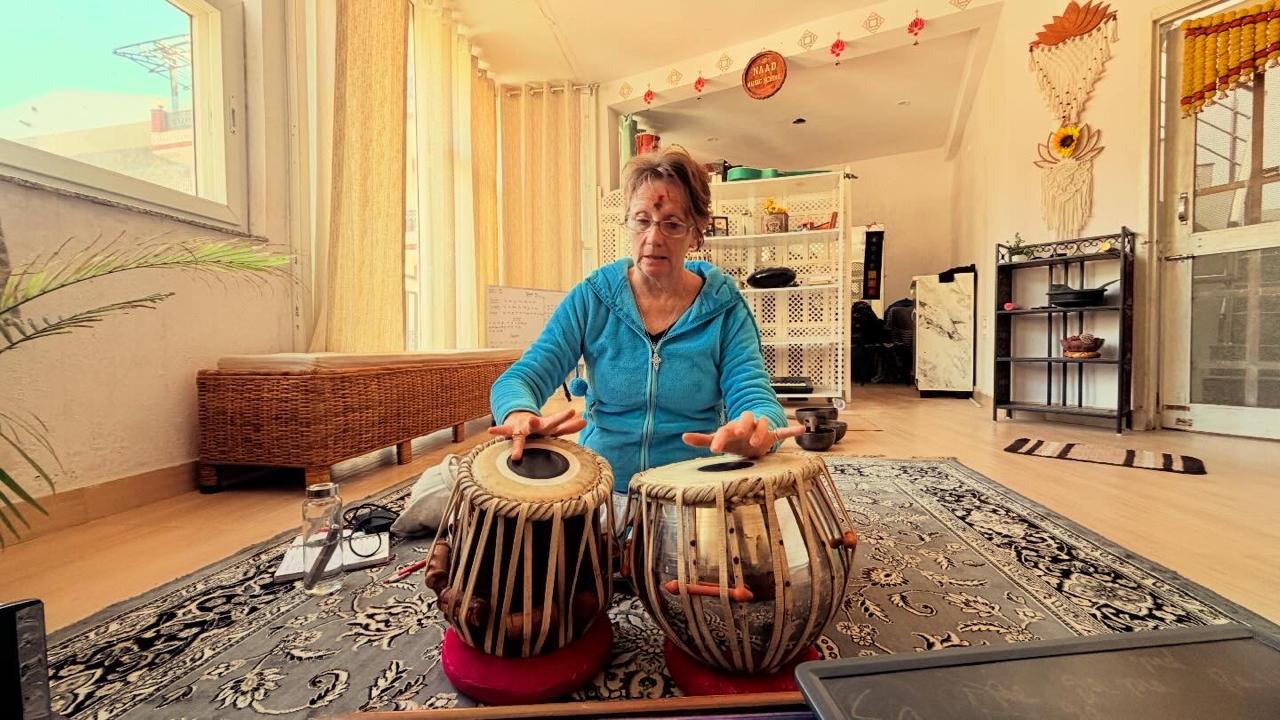
A one-to-one lesson at Rishikesh Music Class
The lesson sets the direction — riyaz is where the actual learning happens

A Structure That Works

Here is the shape I give students, adjusted for instrument and level. The proportions matter more than the exact minutes.

1. Tuning and drone — 5 minutes

Set your tanpura or app and tune properly. Not approximately. This is also when your ear switches on for the session, and skipping it means the first ten minutes of everything else is done with a cold ear.

2. One long note — 5 to 10 minutes

Sa, held, against the drone. Every day, at every level, for your entire life. Advanced players do this more attentively than beginners, not less. It is the most concentrated form of pitch and tone work available.

3. Sargam and alankar — 10 to 15 minutes

Scale patterns, ascending and descending, in every permutation. This is technical maintenance: it keeps the fingers or voice fluent and the note positions accurate. Vary the tempo, and spend most of it slow.

4. The difficult thing — 15 to 20 minutes

The core of the session, and the part students skip. Take precisely the phrase you cannot play. Slow it until you can play it correctly three times consecutively. Then — and only then — raise the tempo by a small increment. If you fail, drop back. This is unspectacular and it is where the improvement actually comes from.

5. Raga or composition — 10 to 15 minutes

Play the raga you are studying. Alap if you have started it. Let this part be musical rather than corrective; you have earned it.

6. Free playing — 5 minutes

Anything you like, with no standard applied. This is not padding. It is the reason you will sit down again tomorrow, and protecting your appetite for the instrument is a legitimate part of practice design.

Two rules I insist on

Never practise a mistake up to speed. Repetition does not distinguish between correct and incorrect — it only strengthens whatever you actually did. Playing a passage wrong fifty times teaches your hands to do it wrong reliably.

Stop before you are exhausted. Practice done with degraded attention embeds sloppiness, and worse, it teaches you to associate the instrument with fatigue. Finish while you still want to continue.

Riyaz in a Real Life

The romantic image is four hours before dawn. Most of my students have jobs, children, or both, and I am not interested in prescribing a routine that only a full-time musician could follow. What follows works for people with ordinary lives.

Fix the time, not the duration. A specific hour each day removes the daily negotiation about whether to practise, and that negotiation is what kills routines. Early morning wins if you can manage it — the voice and mind are unhurried and nothing has yet gone wrong with the day.

Leave the instrument out. Trivial and disproportionately effective. An instrument in a case at the back of a cupboard adds a decision point; an instrument on a stand does not.

Twenty minutes counts. On a bad day, do twenty. The purpose is to keep the chain intact, because a broken chain is much harder to restart than a short session is to complete.

Record yourself weekly. Uncomfortable, indispensable. You do not hear yourself accurately while playing — attention is on production, not reception. A recording is the closest thing to your teacher's ear, and it will disagree with your self-assessment in useful ways.

Keep a one-line log. Date, what you worked on, one sentence on what happened. Its value is not motivational bookkeeping; it is that after three months you can see whether you have been circling the same problem, which is otherwise almost impossible to notice.

Plateaus, and the Truth About Them

Every student hits a stretch, usually somewhere between months four and eight, where nothing seems to improve. Several give up here, which is a shame, because the plateau is largely an artefact of how perception develops.

What happens is that your ear improves faster than your hands. You have started to hear flaws that were previously inaudible to you, so your playing sounds worse to you than it did in month two — despite being objectively better. The gap between what you can hear and what you can produce has widened, and that gap is experienced as failure when it is in fact the precondition for progress. Nobody fixes a problem they cannot hear.

The practical response is unheroic. Keep the routine. Shrink the goal — one phrase, not one composition. Return to a piece from three months ago and notice, honestly, how much easier it has become. Then wait it out, because it does end, and it ends without warning.

RiyazPracticeTanpura AlankarSlow PracticeDiscipline
Devotional Music

Kirtan and Mantra: Music You Are Not Meant to Perform

Essay 07 10 min read Amresh Kumar

In a kirtan there is no audience. This is the first thing to understand, and almost everything else about it follows from that single structural fact.

A concert has two groups: those making the music and those receiving it. A kirtan has one group. The person with the harmonium is not performing; they are leading. Everyone else is not listening; they are answering. Remove the distinction between stage and room, and you get a form of music with a completely different set of priorities.

Call and Response

The mechanism is simple enough to explain in a sentence. The leader sings a line. Everyone sings it back. The line repeats, changing slowly — a little faster, a little higher, a little louder — for anywhere between four minutes and an hour.

What makes it work is what it demands of participants, which is almost nothing. You do not need to read anything, know the language, or have any training. You need only to hear a short phrase and repeat it. Within two or three cycles, a room of complete strangers is singing together in tune. I have watched this happen with people who arrived insisting they could not sing, and it happens reliably because the form is designed for exactly that person.

“The least trained voice in the room is often the most useful one — it gives everyone else permission.”

What I tell students who say they cannot sing

The musical structure underneath is deliberately modest. Kirtan usually sits in simple, direct ragas — Bhairavi, Kafi, Khamaj — and in accessible rhythms, most often Keherwa in eight beats or Dadra in six. This is not a lack of sophistication. Complexity would exclude people, and exclusion defeats the purpose.

Kirtan singing with harmonium in Rishikesh
Harmonium, kartal, dholak — and a room with no audience in it

Repetition as a Technique

Newcomers to kirtan often ask, politely, whether the repetition is not simply the result of a limited repertoire. It is worth answering directly: the repetition is the technique. It is doing the work.

Sing a phrase four times and you are still reading it — attending to the words, the pitch, whether you have it right. Sing it forty times and something measurable changes. The words stop being processed as language. The melody runs without supervision. Attention, having nothing left to manage, settles.

This is not a claim about anything supernatural. It is a fairly ordinary observation about how sustained rhythmic activity affects attention, and you can notice it in yourself with no beliefs required. The tradition arrived at the method by observation, long before anyone had vocabulary for it.

The gradual acceleration is part of the design too. A kirtan that begins slowly and ends fast produces a rise in collective energy that no single participant is generating deliberately. Then it stops — and the silence immediately after a long kirtan is unlike ordinary silence in a way most people notice the first time, and cannot quite describe afterwards.

Mantra: Sound Chosen for What It Does

Mantra chanting overlaps with kirtan but its emphasis differs. Kirtan is communal and melodic. Mantra is precise, often solitary, and concerned less with tune than with exact sound.

A mantra is a specific sequence of syllables treated as effective in itself. Not a description of something, not a request — the sound is the instrument. Which is why pronunciation is taken so seriously: uchcharan, correct articulation, is considered part of the practice rather than pedantry about it.

Three things are usually taught together:

Placement. Where in the body the sound resonates. Chest, throat, palate, the space behind the nose. Different mantras are directed differently, and you can feel the difference plainly once someone points it out.

Breath. Chanting on the exhale, with the phrase fitted to a comfortable breath length. A mantra that runs out of air is being chanted wrongly regardless of accuracy.

Count. Traditionally 108, tracked on a mala so counting does not occupy attention. The number matters less than the fact that a fixed count removes the question of when to stop, which is otherwise a small, constant distraction.

Why every class here opens with Ganesh Vandana

Before any lesson at this school, student and teacher chant together — a short invocation to Ganesha, the remover of obstacles. It takes under a minute.

No belief is required and none is asked about. It warms the voice, lengthens the breath, calms a nervous student faster than reassurance does, and puts everyone in the room on the same pitch before the first real note. It is also a marker: it separates the class from the day around it.

The Instruments, and Why They Are What They Are

Harmonium. The standard leader's instrument. It sustains, so it holds the pitch for the room continuously, and it can be played adequately with one hand while the other works the bellows — which means the leader can sing without effort. Its fixed tuning is a genuine limitation in classical raga work; in kirtan, where the priority is keeping thirty people in tune, that same fixedness is the entire virtue.

Kartal and manjira. Small hand cymbals. Anyone can play them within thirty seconds, which is exactly the point — they let people participate rhythmically without any skill barrier.

Dholak or mridang. A two-headed drum, warmer and less precise than tabla, well suited to the simple cycles kirtan uses.

Tabla, sometimes, when a trained player is present. Capable of far more than kirtan requires, and a good kirtan tabla player knows to hold most of it back.

For the Musician Who Finds It Too Simple

Trained musicians sometimes struggle with kirtan, and I have some sympathy. The harmony is basic, the rhythms are elementary, and there is no room to demonstrate anything you have spent years learning.

My suggestion is to reconsider what is being attempted. Leading a kirtan well is a real skill and it is not a musical one in the usual sense. It requires reading a room — sensing when to lift the tempo, when to hold, when to drop the volume so people can hear themselves, when a group is ready for the next stage and when pushing would lose them. It means keeping thirty untrained voices together, which is harder than keeping a trained ensemble together. And it demands the discipline to play considerably less than you are capable of, because your job is to support rather than to be interesting.

Judged as a performance, kirtan is unimpressive. Judged as what it actually is — the craft of getting a room full of strangers to sing as one thing — it is difficult, and it is worth learning.

KirtanBhajanMantra HarmoniumKeherwaCall and Response
The Art of Listening

How to Listen: The Skill Nobody Teaches and Everybody Needs

Essay 08 12 min read Amresh Kumar

If I could give a student one hour a day and choose how it was spent, I would not always choose practice. For many students, forty minutes of playing and twenty minutes of deliberate listening produces more progress than sixty minutes of playing. It is also the recommendation students most reliably ignore.

The reason it works is straightforward. You cannot produce what you cannot hear. A phrase you have never properly perceived is not available to you, no matter how skilled your hands become. Listening is not the passive counterpart to practice; it is where the target gets installed.

Passive Enjoyment Versus Active Recognition

Most people listening to Indian classical music are having a pleasant, vague experience. It sounds beautiful. Something is happening. They could not say what.

Active listening means you can narrate it. Not in technical language necessarily, but you know what the musician just did and roughly why. The transition from the first state to the second is the fastest-improving skill available to a student, and the majority of students never deliberately attempt it — which is a substantial waste, because it costs nothing and can be done on a train.

“Beginners hear a wash of sound. Musicians hear decisions being made.”

The whole difference, in one line

Know the Architecture Before You Listen

A full classical performance follows a shape, and knowing that shape converts a bewildering forty minutes into a sequence you can follow.

Alap — unmetered introduction

No rhythm, no tabla. The musician introduces the raga note by note, establishing its character. Slow, exploratory, apparently formless — and not formless at all. Listen for which note the phrases keep returning to; that is the vadi, and it is the raga's centre of gravity. This is where a raga is revealed, and the best listening happens here.

Jor — pulse emerges

Still no tabla, but a pulse begins to assert itself in the playing. The mood tightens. Primarily an instrumental section.

Jhala — rhythmic acceleration

Fast, driving, rhythmically emphatic. On sitar this is the rapid drone-string strumming most listeners recognise immediately.

Bandish or gat — the composition

The tabla enters, the cycle begins, and a fixed composition is presented. Now you have something to hold onto: a returning melody and an audible sam to orient by.

Improvisation and laykari

The musician departs from the composition and returns to it. The whole art of the section is in the departures and how precisely they land back on sam. Listen for the return, not the departure — the return is where the skill is demonstrated.

Drut — fast conclusion

Acceleration to a close, often with visible interplay between soloist and tabla player.

Teacher and student listening together at Rishikesh Music Class
Guided listening — often the most productive twenty minutes of a lesson

A Method You Can Start Tonight

Take one recording. Not a playlist — one recording, ideally twenty to forty minutes, of a raga you are studying or about to study. Then work through it in passes, on separate days.

Pass one: just listen. No analysis. Get familiar with the shape of the thing so it stops being unfamiliar. Familiarity has to come first or every subsequent pass is spent on orientation.

Pass two: find Sa. Locate the drone and hum it under the recording. Hold it throughout. This is harder than it sounds and it is the foundation of everything else — you cannot hear a note's function until you know where home is.

Pass three: track the vadi. Notice which note the phrases resolve to. Sing it. You are now hearing the raga's structure rather than its surface.

Pass four: count the cycle. Once the tabla enters, find sam and count sixteen. Lose it, find it again. Losing it repeatedly is the exercise, not a failure of it.

Pass five: catch one phrase. Find a single phrase you like, of two or three seconds. Replay it ten times. Sing it. Then play it on your instrument. This is where listening turns into technique, and one phrase learned this way is worth more than an hour of undirected practice.

On repeated listening

Twenty listens to one performance teaches more than one listen to twenty performances. This runs against every instinct that a large music library encourages.

The reason is that recognition requires repetition. On the first hearing you notice melody. By the tenth you notice ornaments, breathing, hesitations, and where the tabla player pushes. None of that was added — it was always there, and your ear had not yet arrived at it.

Gharana: Why Two Great Musicians Disagree

Once you listen closely, you will notice that two celebrated players of the same raga do markedly different things — and you will want to know which one is right.

Neither. Or both. Indian classical music is transmitted through gharana, lineages of teaching, each with its own emphases, characteristic phrasings and pedagogical priorities. One favours slow, expansive alap; another prizes rhythmic intricacy; another emphasises purity of note placement above expressive licence. These are traditions of interpretation, not competing claims about a fact.

This matters practically for your listening. Do not average across ten players in an attempt to find the correct version — you will end up with a blur. Choose one recording and one interpretation to learn from, get it thoroughly into your ear, and only then start comparing. Comparison is genuinely valuable, but it is a second-stage activity, and doing it first prevents anything from taking root.

What Improves, and Roughly When

Listening progress is easier to observe than playing progress, which makes it unusually encouraging for students in a plateau.

Month one. You can find Sa in most recordings and follow the general shape of a performance.

Month three. You can identify the ragas you have studied within a minute or so, and you can hear when a phrase resolves properly.

Month six. You catch ornaments as they happen — a meend, an andolan — and you notice tabla and soloist responding to each other rather than merely coexisting.

Year one. You have preferences you can defend, and you can say something specific about why one performance moves you more than another. This is taste, and taste is the beginning of being a musician rather than a player.

None of this requires an instrument in your hands. It requires attention, one recording at a time, repeatedly — and it is the closest thing to a shortcut that this music offers.

ListeningAlapJorJhala BandishGharanaLaykari
Amresh Kumar, Rishikesh Music Class

Amresh Kumar

Founder & Teacher · Rishikesh Music Class

One-to-one instruction in raga studies, bansuri, tabla, harmonium, voice, kirtan and Naad yoga at Sant Sewa Ashram, Laxman Jhula, Rishikesh. Traditional guru–shishya method, taught in English and Hindi, offline and online.

From Reading to Playing

Everything Here Is Taught One to One.

These essays are the thinking behind the courses. If any of it made you want to pick up an instrument, each subject below is taught individually at Laxman Jhula — in person or online, in 10, 15 or 30-session courses.

Raga studies course in Rishikesh
CourseIntermediate+

Raga Studies

Grammar, thaat, time cycles, mood, alap and improvisation — for students who already play or sing.

View course
Bansuri flute course in Rishikesh
CourseAll levels

Bansuri Flute

Breath, embouchure, tone and meend on the bamboo flute, from first note to raga playing.

View course
Tabla course in Rishikesh
CourseAll levels

Tabla

Bols, hand technique, teentaal and beyond — the discipline that fixes your sense of time for good.

View course
Voice training course in Rishikesh
CourseAll levels

Voice Training

Breath support, sur, sargam and range — the most direct route into this music, with nothing to buy.

View course
Harmonium course in Rishikesh
CourseAll levels

Harmonium

Bellows, fingering, accompaniment and leading — the instrument that holds a room in tune.

View course
Kirtan course in Rishikesh
CourseNo experience

Kirtan & Mantra

Call and response, harmonium leading, pronunciation and the craft of carrying a room.

View course
Naad yoga course in Rishikesh
CourseNo experience

Naad Yoga

Sound as practice rather than performance — breath, resonance, chanting and deep listening.

View course
Online Indian music classes
CourseWorldwide

Online Classes

Live one-to-one lessons over Zoom, Meet or WhatsApp video, scheduled to your time zone.

View course
Keep Reading

New Essays as They Are Written

This journal is written slowly — a piece appears when there is something worth saying rather than on a schedule. If you would like to know when the next one is published, send a message on WhatsApp and we will let you know. No lists, no mailings, nothing automated.

Learn With Us

Reading Is a Start. Playing Is Better.

If something in these essays landed, the next step is an hour with an instrument in your hands. Send the short form across and it opens directly in WhatsApp with your details already written out. We reply personally — usually within a few hours — with availability, the current fee for your chosen course, and a suggested start date.

  • No payment or card details required to enquire.
  • We confirm your time slot before you travel.
  • Trial session available if you would rather try first.
  • Available for both in-person and online students.

Course Inquiry

Takes under a minute to fill.

Opens in WhatsApp with your details filled in.
Nothing is stored on this website.